

GOOD DATA HAPPY FANS
“Turning customers into fans” – this claim is often the guiding principle when companies actively look after their existing customers. But what if the customers are soccer fans and the objective is to turn these fans into customers? We provide a brief insight into our collaboration on the topic of data quality with one of the top clubs in the German Football League.

Challenge: Data in front, one more goal
When the members’ magazine is sent out twice a year, fans rejoice. Unless the booklet doesn’t arrive. Then the faces are long. This happens when addresses become outdated, recipients move, or even incorrect names are recorded in the CRM system. The challenge: data quality. And this plays a prominent role not only in the mailing of member magazines.
Fan campaigns, member analysis, fan support and much more also come to nothing or are simply not feasible without good data. Together with the Schober Information Group, a Bundesliga club has therefore vigorously tackled the issue of data quality. The goal: to increase data quality, expand the depth of information through data enrichment, and create a solid data foundation for the use of analytics and artificial intelligence (AI) in direct and digital marketing.
Solution: Data quality check and data depth enrichment
 The Data Quality Check project was launched. This compares the CRM data of the association with the current data from the Schober data universe. The comparison shows: gaps in the data, outdated data, incorrect data or duplicates. As a rule, according to Schober’s practical experience, about 15% of the master data in CRM systems must be updated within a year. The younger the target group, the more mobile and the more frequent the need for updates.
After the check, the need for action is determined and the association decides to update and populate its own data (First Data) with Schober third-party data. Additionally, one uses the option to increase the data depth. This means that Schober offers additional information beyond current address data. Socio-demographic data, development at the place of residence, purchasing power information and many more details can be added.
Outlook: Analyses, but please automated and secure
The association has gained a solid data foundation for more in-depth analyses. After all, you don’t gain any insights from false data. Only those who can create added value for their fans and members thanks to good data can take the lead. And this is exactly where it should go: from data by means of analysis, information about fans, their joys and requirements is obtained.
The methods and analysis strategies can be diverse. Typically, cluster analysis, AI, and self-learning algorithms are used in such scenarios in addition to simple data mining with pattern recognition. Of course, all of this is done in compliance with DSGVO – security and data protection have the highest priority for us. Our membership in DDV as well as certifications by CSA and IABEurope underline our claim to secure and DSGVO-compliant data handling.
In the next step, the Bundesliga club plans to derive targeted marketing measures from the analyzed data. Who is a casual fan and only comes to the stadium in good weather? Which fans don’t need advertising because they are in the stadium for every home game anyway? Which fans have a pet and would be delighted with the original feeding bowl with club logo? These are just a few examples of questions that can be answered easily and automatically with the right methodology.
If you also want to play in the premier league with your data…
If you want to follow our customer’s example and play in the first league with data-based marketing, please contact us. At Schober, we have been shaping the future of sales and marketing for over 75 years.  And the method described above has long since given rise to a cloud-based out-of-the-box platform for managing customer data (Customer Data Platform – CDP). We call the solution udo and think you should get to know udo. We would be happy to show you how easy udo can also turn your fans into customers or even happier fans.
Simply play in the premier league with your data.

 Know your customers and target groups for successful marketing, selective analyses and a professional customer approach. With an automated enrichment of current additional data via API from the Schober data universe, you create the prerequisite for this valuable qualification of your data stock.
 Use our interface to immediately and easily access our extensive company and contact database in the B2B area as well as our personal database in the B2C area. In this way, our API supports you in digitizing and automating your business processes and improves the data quality in your CRM or ERP system.

 Solving complex challenges and curiosity are two central motives in her life. And challenge is not the usual business phrase: Katrin gets to the bottom of things. Since April 2020, she has been working at Capaneo (formerly Schober) as Head of Digital Strategy to drive the roadmap of the
  She is also fascinated by travel and contact with a wide variety of people in her private life. At a young age, she begins to explore the world on her own. As opportunities increase, so does the travel radius; to date, she has visited over 70 countries. And here, too, she likes to get to the bottom of things: on the occasion of her trip to Indonesia, for example, she organizes a two-week stay at an orphanage in advance to participate in local life. Among many other destinations, she repeatedly goes to sub-Saharan Africa, where she also meets her current husband Munene. But until the wedding in 2018, it should then take a moment.



 Just as close to the customer, but with a different focus, are their projects around the
  Since January 2018, he has been working as a Data Scientist at Capaneo, where he ensures that data is transformed into insights for effective marketing measures within the analysis team. In addition to standard applications, Andreas manages complex customer projects involving new data and complete analyses –
 Sylvia has been working at Schober Information Group Germany (now Capaneo) since 2010, most recently as Chief Operating Officer and member of the operational management team. Through
  Travel, travel, travel
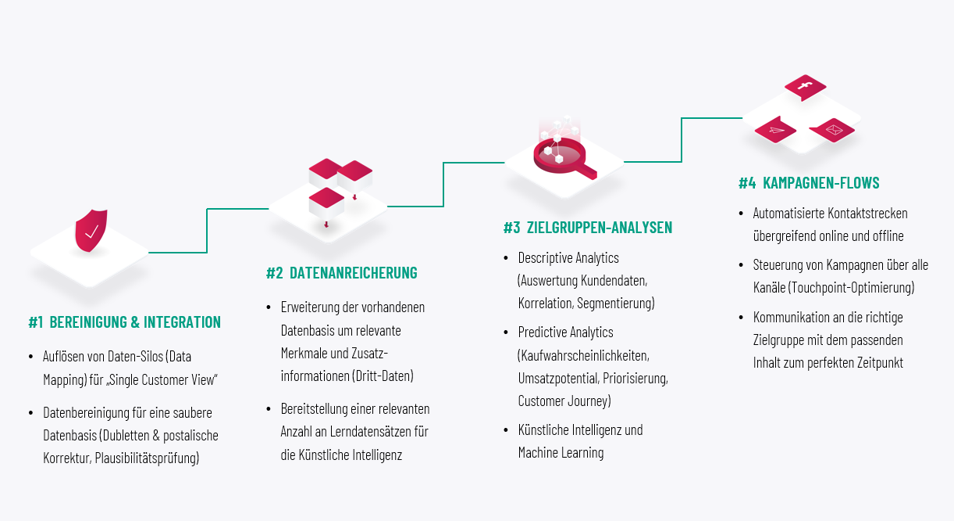
 The first step is to create a data basis. To this end, companies ensure the central provision of all data related to the intended customer interaction. Centralized is important, because most of the time data lies unconnected in different transaction systems (ERP, e-commerce system, content management, etc.) next to each other. Only the mapping of the data silos creates the basis for further analyses. Because if companies use incorrect or incomplete data, they will also receive only incorrect or incomplete results when evaluating it. The supposed treasure trove of data then quickly turns out to be data garbage.
 But sometimes the depth of information in the existing data is not enough. Therefore, at stage two, one examines the existing database against the background of the business and communication objectives. If necessary, the depth of information is increased in order to create the right added value in the customer interaction. Typical additions here include geodata, data on the degree of digitization, IT systems used, or corporate structure, depending on the potential customer target group.
 In stage three, this data becomes information. Analytics and AI turn data into information about prospects, customers, and their needs. Methods and analysis strategies are diverse and depend on the task. Typically, cluster analysis, artificial intelligence and self-learning algorithms are used in addition to simple data mining with pattern recognition. With the insights gained, companies can make value-oriented interaction and product offers.
 Stage four moves to action, using the insights from the previous stages to convince addressees of the value of the products on offer. That is exactly what value-based selling is. In principle, all available channels and content formats are used for interaction, and the selection of suitable information media can usually be determined very precisely at the previous stages.